
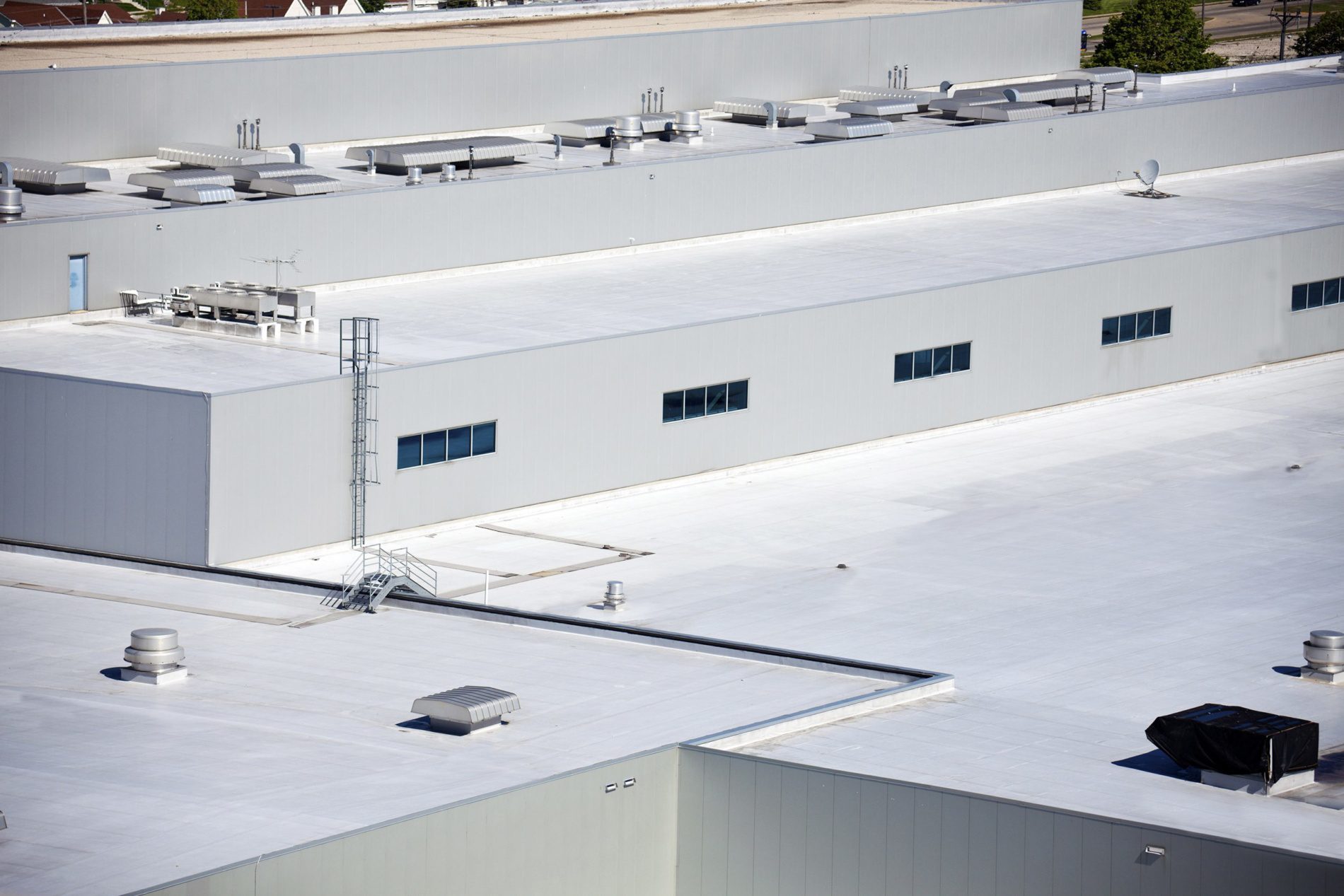
Baton Rouge sits at the heart of Louisiana's petrochemical corridor, and ExxonMobil's massive refinery complex — one of the largest in the United States — anchors an industrial cluster where commercial roofing must meet process safety requirements that go far beyond standard commercial specifications. Manufacturing facilities across the Baton Rouge area, from petrochemical plants to polymer processors to industrial equipment manufacturers that serve the refinery corridor, operate in an environment where roofing system failures have consequences that extend into production safety and environmental compliance.
Process equipment on Baton Rouge manufacturing roofs is shaped by the petrochemical industry's demanding process requirements. Cooling towers for process temperature control, industrial exhaust and gas management systems, and atmospheric relief equipment are standard on refinery-adjacent manufacturing facilities. These systems are often safety-critical — their operational integrity is part of the facility's process safety management plan. We document all roof-mounted equipment thoroughly before mobilizing, obtain safety management plan requirements from facility HSE teams, and design work sequences that never compromise safety system operability. Our field supervisors hold PEC SafeLand and OSHA 30 certifications required for Louisiana petrochemical facility work.
Chemical and fume exposure at Baton Rouge manufacturing facilities is among the most aggressive in the country. Hydrocarbon vapors from refinery and polymer processing operations attack petroleum-based roofing compounds and can degrade synthetic membranes at rates that standard manufacturer service life projections do not reflect. Sulfur compounds, organic acids from process streams, and ammonia from chemical operations all contribute to a chemical attack environment that requires careful membrane specification. We obtain facility chemical inventory and emission data, consult membrane manufacturers' technical teams, and specify systems with documented resistance to the relevant compound families at each facility.
Louisiana's subtropical climate adds a biological dimension to chemical attack on Baton Rouge manufacturing roofs. High humidity, warm temperatures for most of the year, and organic nutrients from industrial processes create conditions where biological communities can establish on membrane surfaces and in drain systems. Algae, fungi, and bacterial biofilms generate organic acids that degrade membrane surfaces and contribute to drain blockage. We specify antimicrobial membrane formulations where biological growth is likely, design drain systems with biological growth resistance, and include biological community management in our service protocols for Baton Rouge industrial clients.
Hurricane and tropical storm exposure is a primary design driver for Baton Rouge manufacturing roofs that often receives inadequate attention. Louisiana's wind zone requirements under the Louisiana State Uniform Construction Code mandate uplift resistance calculations for the specific risk category of each facility. Process and manufacturing facilities carrying significant equipment loads are often Risk Category III or IV, which imposes wind uplift requirements significantly higher than standard commercial buildings. We calculate uplift resistance for the specific risk category of each facility, specify FM-approved systems at the required design wind speed, and use perimeter and corner fastener densities that meet or exceed code requirements.
Vibration from petrochemical and industrial processing equipment at Baton Rouge facilities — rotating equipment, compressors, large pumping systems — transmits into building structures through complex paths. Industrial buildings in the chemical corridor are often large-span steel structures where vibration propagates efficiently, reaching the roof deck with enough energy to affect fastened membrane systems over time. We assess vibration environment before specifying fastener type and density, use fully adhered systems in high-vibration areas, and specify flexible flashing details at penetrations where equipment vibration would otherwise stress rigid transitions.
Drain design at Baton Rouge manufacturing facilities must account for Louisiana's extreme rainfall intensity and the combination of industrial and biological particulate that accumulates in drain fields. Baton Rouge averages over 60 inches of rainfall annually, and intense convective storms can deliver several inches per hour during summer thunderstorm events. Drain systems sized for average conditions are inadequate here. We size drain fields for Louisiana design storm events, add overflow scuppers at all perimeters, and specify strainer systems appropriate for the particulate types generated at each facility. Biological fouling management in drain lines is included in our service programs for Baton Rouge industrial clients.
Heat management during roofing operations is a serious operational challenge at Baton Rouge manufacturing facilities. With summer heat indices routinely exceeding 110 degrees Fahrenheit and roof surface temperatures above 175 degrees Fahrenheit, roofing work in June through September requires genuine heat illness prevention planning that goes beyond OSHA minimums. We schedule heat-sensitive operations for morning hours, provide mandatory rest and hydration schedules, use wet bulb globe temperature monitoring, and have emergency response protocols for heat illness events. These protocols are not optional — heat stress is a real hazard on Louisiana industrial roofing jobs in summer.
Coordinating reroofing at Baton Rouge petrochemical and industrial facilities requires understanding the turnaround cycle that governs these operations. Major facility maintenance and capital work is concentrated in planned turnaround periods — typically every 3-5 years — and roofing work that misses the turnaround window may need to be postponed significantly. We engage facility planning teams well in advance of targeted turnaround periods, develop detailed scope and budget documents for turnaround planning, and pre-order materials to ensure availability during the turnaround window. Failing to secure a spot in the turnaround schedule is a common planning failure for roofing contractors without industrial market experience.
- Do you hold certifications required for Louisiana petrochemical facility work?
- Yes. Our field supervisors hold PEC SafeLand certification and OSHA 30, and we complete site-specific safety orientation for every petrochemical facility. We maintain familiarity with the major operator safety management systems in the Baton Rouge corridor including ExxonMobil, Shell, and BASF contractor management programs.
- How do you specify roofing systems for the Louisiana wind zone?
- We calculate uplift resistance per ASCE 7 for Louisiana's wind zone and the specific risk category of each facility. Manufacturing and process facilities often require Risk Category III or IV uplift calculations, which mandate significantly higher fastener density than standard commercial specifications.
- What membrane types resist hydrocarbon vapor exposure in refinery-adjacent environments?
- KEE formulations and select TPO compounds with documented hydrocarbon resistance are typically specified for refinery-adjacent applications. We obtain facility emission data and verify membrane resistance ratings with manufacturers' technical teams before finalizing specifications.
- How do you work around turnaround scheduling for Baton Rouge petrochemical facilities?
- We engage facility planning teams 12-18 months before targeted turnaround windows to develop scope and budget, pre-order materials, and secure crew availability. Turnaround windows are short and oversubscribed — early planning is essential for getting roofing work into the schedule.
- What biological growth management does your service program include?
- Our Baton Rouge service agreements include semi-annual drain inspections with biological fouling clearance, antimicrobial drain treatment where conditions warrant, and membrane surface inspections for biological growth requiring intervention. Louisiana's climate makes this a necessary element of any meaningful service program.