
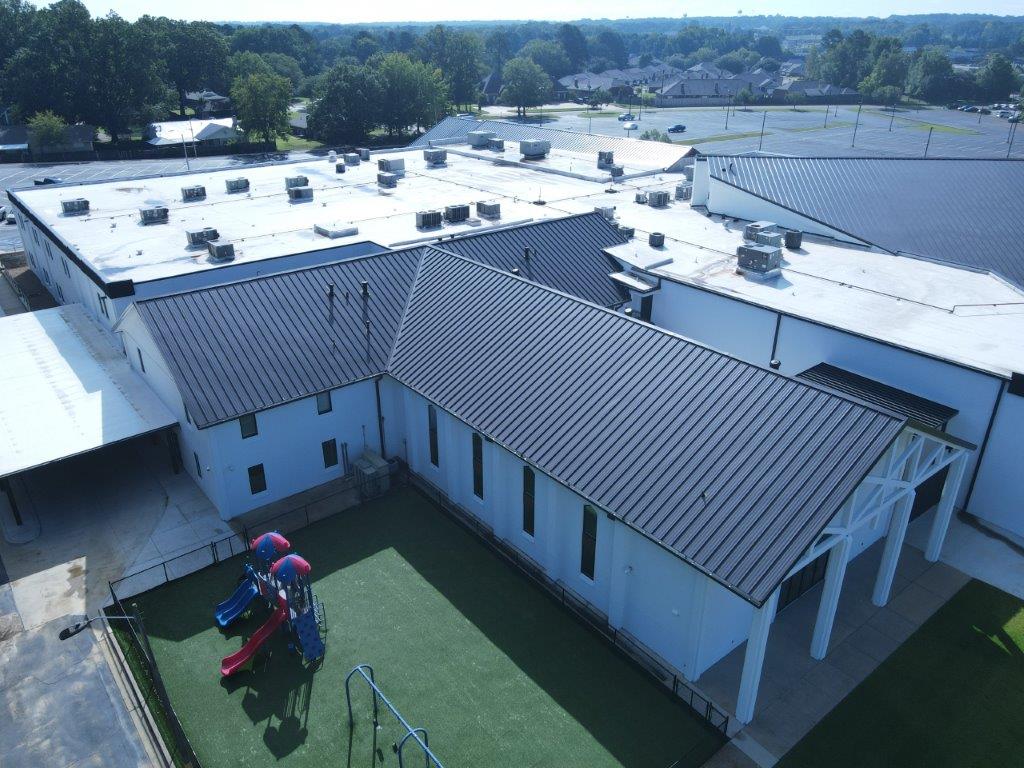
Istrouma Baptist Church in Baton Rouge is one of Louisiana's most prominent evangelical congregations, its large campus in the heart of East Baton Rouge Parish reflecting decades of growth in a city where faith community is central to daily life. The roofing environment in Baton Rouge is among the most demanding in the United States: annual rainfall exceeding 62 inches, a hurricane season that runs from June through November, extreme summer heat and humidity, and a substrate moisture environment that challenges even well-installed membrane systems in ways that contractors from drier climates routinely underestimate.
Hurricane and tropical storm risk defines the roofing specification conversation for every large church in the Baton Rouge metro area. The Louisiana Department of Insurance and the state's adopted building code require commercial roof systems to be designed for wind uplift loads consistent with ASCE 7 wind speed maps, and the wind speed contours for Baton Rouge and surrounding East Baton Rouge Parish are significantly higher than the national average. Church buildings in this market must specify mechanically fastened or fully adhered membrane systems with engineered fastener patterns, and the fastener pull-out values used in the design must be based on actual test results from the specific deck type present in the building rather than published table values.
Clear-span sanctuary construction in Baton Rouge churches spans multiple eras, from the postwar boom-era buildings of the 1950s and 1960s to the contemporary worship center campuses of the 1990s through 2010s. The older buildings in this inventory frequently carry built-up roofing systems that have exceeded their useful life and may contain asbestos-containing materials in the base ply or in roofing mastic at drain collars and flashing areas. Any re-roofing project on a pre-1980 Baton Rouge church should include asbestos testing of the existing system before tear-off work begins, because the presence of ACM changes both the removal method and the disposal requirements in ways that significantly affect project cost and schedule.
Baton Rouge's extreme heat and humidity create a roofing installation environment that demands attention to material handling and adhesive cure conditions. TPO membrane adhesive applications require minimum substrate temperatures and maximum dew point conditions that may not be achievable during Baton Rouge's summer months, when overnight temperatures rarely drop below 75 degrees and relative humidity regularly exceeds 85 percent. Experienced South Louisiana roofing contractors know which products perform in these conditions and which don't, and a contractor who is new to the Louisiana market may specify products whose installation requirements are incompatible with the actual climate conditions on site.
Steeples and cupolas on Baton Rouge's Baptist, Catholic, and mainline Protestant churches have been tested by decades of tropical weather events, and their flashing systems deserve a dedicated assessment before any major roof work begins. Hurricane-related wind can work flashing laps loose and open sealant joints at steeple base connections in ways that appear cosmetically minor from below but provide an active water infiltration pathway during the next significant rain event. A contractor who addresses only the main roof membrane without assessing these elevated features is leaving a known vulnerability in place.
Scheduling major church roof work in Baton Rouge is constrained by the dual pressure of hurricane season risk and summer heat. The practical windows are April through mid-May and October through November, before and after the most active hurricane months and before summer heat makes outdoor work genuinely hazardous. Many Baton Rouge churches run Vacation Bible School in June, and several large congregations have conference and retreat programming in late July and August that keeps the building in active use during the hottest months. Confirming the full calendar of church programming before setting the construction window is essential—surprises mid-project create conflict that is entirely avoidable with early communication.
Louisiana's faith communities have unique capital funding resources that building committees should investigate before assuming the full project cost falls on congregational giving. The Louisiana Disaster Recovery Foundation and several faith-based recovery organizations have provided roofing funding to churches that suffered storm damage in designated disaster events. The Diocese of Baton Rouge and the Louisiana Baptist Convention both maintain facilities assistance programs for affiliated congregations. For congregations in low-to-moderate income communities, CDBG-DR federal funds administered through the Louisiana Office of Community Development have historically been available for community-serving facilities including churches after major disasters.
Louisiana's contractor licensing requirements mandate that commercial roofing contractors hold a current Louisiana State Licensing Board for Contractors license appropriate to the project type and value. Verify licensure status through the LSLBC's online search before executing any contract. The City of Baton Rouge and Parish of East Baton Rouge administer building permits for commercial construction, and permit requirements for roof replacements include structural plan review for projects that add or change the loading of the roof assembly. Louisiana's adopted energy code applies to commercial roof replacements and mandates cool roof reflectivity values that reduce cooling loads in Climate Zone 2A.
Any large church roof project in Baton Rouge should include a post-hurricane-season inspection as a recurring annual maintenance item built into the roofing system warranty maintenance requirements. Major manufacturers who issue warranties for Louisiana commercial projects are accustomed to providing post-storm inspection services after named hurricane events, and understanding whether your manufacturer offers this service before selecting the roof system is a practical criterion that should be part of the specification evaluation process. A warranty that covers hurricane damage but requires the congregation to prove the specific storm caused the damage—rather than the manufacturer conducting a proactive post-storm inspection—provides meaningfully less protection in a market where storm events are frequent.
- What wind speed should a Baton Rouge church roof be designed for?
- Baton Rouge falls in an elevated wind speed zone under ASCE 7 wind speed maps. A licensed engineer should calculate the design wind pressure for your specific building, but most large church buildings in East Baton Rouge Parish will require design wind speeds of 115 mph or higher. Fastener pull-out values used in the uplift calculation must be based on actual field testing of the existing deck, not published table values.
- Does our pre-1980 church roof likely contain asbestos?
- Possibly. Built-up roofing systems installed before 1980 frequently contain asbestos in the base ply felts or in roofing mastic at drains and flashings. Louisiana requires asbestos testing before demolition of suspect materials, and if ACM is confirmed, removal must be performed by a licensed asbestos abatement contractor. Include asbestos testing in the project scope and budget before soliciting contractor bids.
- When is the best time to schedule major church roof work in Baton Rouge?
- April through mid-May and October through November are the optimal windows, avoiding the peak hurricane months of August and September and the extreme heat that makes safe outdoor work difficult in June through August. Confirm the church's full programming calendar before setting the construction window to avoid conflicts with summer VBS and fall conference programming.
- Are there post-disaster funding sources for church roofing in Louisiana?
- Yes, after declared disaster events. CDBG-DR funds administered through the Louisiana Office of Community Development, the Louisiana Disaster Recovery Foundation, and faith-based recovery programs have all provided roofing assistance to Louisiana churches after major hurricanes. Eligibility requirements and application processes vary by program and by disaster declaration.
- What should we look for in a Baton Rouge roofing contractor's experience?
- Prioritize contractors with documented experience in South Louisiana's specific climate—not just general Gulf Coast experience. Verify Louisiana LSLBC licensure, ask for references from church projects completed in East Baton Rouge, Ascension, or Livingston parishes in the past five years, and confirm that the contractor has experience with post-storm inspection and insurance claim documentation, which will be relevant at some point during the roof's 20-to-25-year life.