
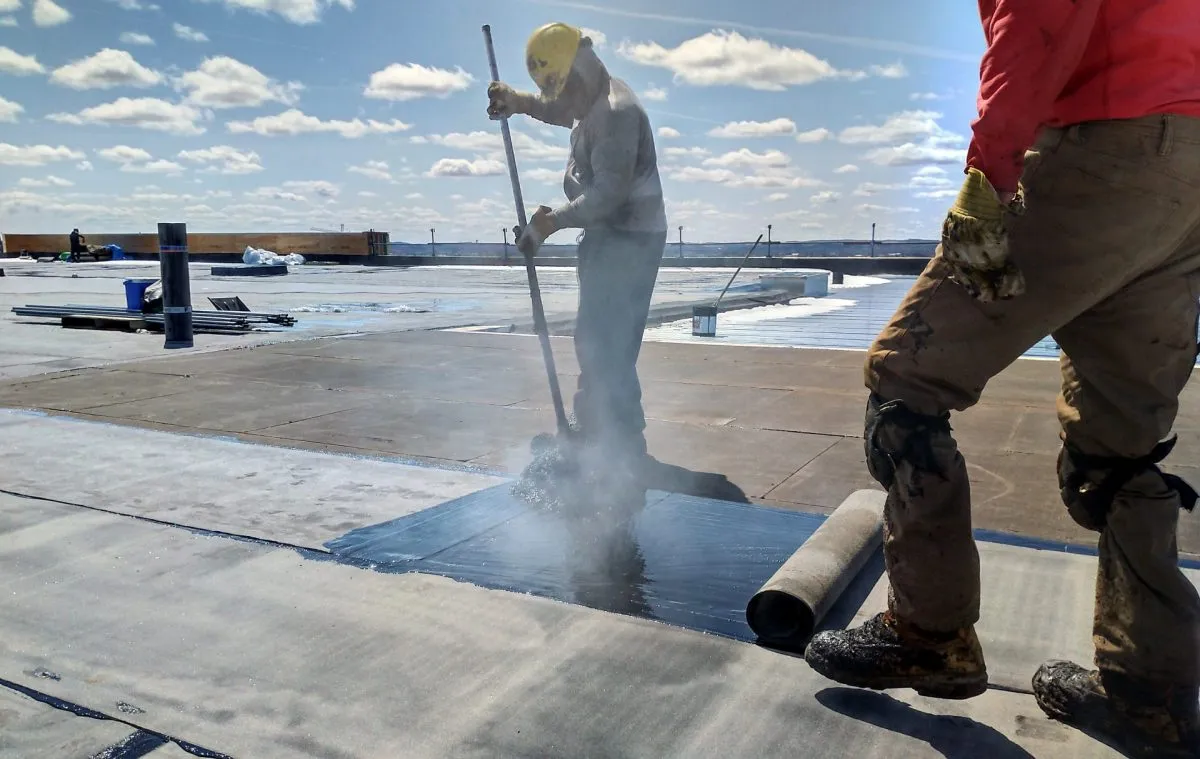
A built-up asphalt call in Baton Rouge usually starts with a business problem inside the building. For built-up asphalt, we identify the buyer, the roof condition, the leak history, and the operating risk before we talk about membrane brand or square-foot price. owners comparing roof assemblies before a bid is written need a built-up asphalt scope that explains what is failing, what can be repaired, and what the next decision costs.
The first walk for built-up asphalt is practical: roof access, deck type, drainage, curbs, wall transitions, prior repairs, interior leak locations, and tenant-sensitive areas below the roof. On built-up asphalt work, we separate maintenance items from capital items and keep photo evidence organized by roof area. The built-up asphalt file also notes wind-driven rain at parapet walls, because that is one common way a small Baton Rouge roof defect becomes an interior damage problem.
For Built-Up Asphalt, our roof file starts with this local condition: ExxonMobil describes its Baton Rouge operations as one of the largest refining and petrochemical complexes in the world and says its local workforce is about 6,000 people. That matters on built-up asphalt work because buildings near Port of Greater Baton Rouge terminals, Port Allen warehouses, and riverfront industrial roofs do not share the same loading, access, tenant, and inspection constraints. We write those built-up asphalt constraints into the scope so ownership can compare bids on actual field conditions instead of broad sales language.
The Built-Up Asphalt scope is also checked against this Baton Rouge planning fact: Commercial buildings around I-10, I-12, Airline Highway, Siegen Lane, Bluebonnet, Essen Lane, and Industriplex commonly need roof plans that account for traffic, staging, tenants, and rooftop equipment. For built-up asphalt, this affects the schedule, staging, inspection expectations, and the amount of documentation needed before the roof is opened. We prefer to identify permit, product, and sequencing questions early, especially when the built-up asphalt scope touches tear-off depth.
The Built-Up Asphalt schedule has to respect this field reality: The Port of Greater Baton Rouge is located at the head of deepwater navigation on the Mississippi River, with a 45 to 50 foot shipping channel maintained to the mouth of the river. Gulf Coast wind and rain are not abstract issues on built-up asphalt projects; they affect perimeter securement, temporary dry-in rules, drain capacity, and daily production windows. We call those built-up asphalt items out in the estimate so a lower number does not hide a weaker scope.
Built-Up Asphalt is treated as a commercial roof decision because occupancy, access, drainage, deck condition, weather exposure, and owner reporting can change the right scope. For built-up asphalt as roof system work, the useful question is how the local fact changes field execution. On occupied roofs during built-up asphalt, the answer is often phased sequencing, daily dry-in checkpoints, and a closeout file that records what was installed, repaired, or deferred.
The roof system is only one part of a built-up asphalt scope. For built-up asphalt, we also review insulation, recovery board, existing penetrations, rooftop mechanical units, hatch access, lightning protection, drain strainers, overflow paths, and deck condition where it can be verified. Those built-up asphalt details decide whether recover, tear-off, restoration, coating, or targeted repair is credible.
Built-Up Asphalt jobs in Baton Rouge also have a scheduling problem that generic bids often miss. Afternoon rain, hurricane-season forecasts, river corridor security, truck courts, occupied medical buildings, downtown access, and I-10 or I-12 traffic can all change how built-up asphalt work is staged. For built-up asphalt, we would rather write a clean schedule than promise a fast date that leaves a roof open when weather changes.
Cost discussions for built-up asphalt start with square footage, but they do not end there. For built-up asphalt, edge metal, disposal, wet insulation, night or weekend work, crane access, rooftop equipment, and concealed deck issues can move the number more than the roof membrane alone. Our built-up asphalt proposals separate base scope from alternates so ownership can see what is required, recommended, and optional.
Documentation is part of the built-up asphalt work, especially for property managers, REIT teams, public owners, industrial operators, and facility directors. For Built-Up Asphalt, we keep photos, notes, repair locations, product information, and closeout observations organized so the roof can be managed after the invoice is paid. That built-up asphalt file helps during lender reviews, warranty conversations, insurance review, future capital planning, and tenant communication.
We are careful about what we do not promise on built-up asphalt scopes. On built-up asphalt, we do not call a saturated roof a coating candidate because the surface looks clean, we do not ignore loose edge metal because the field membrane looks intact, and we do not price a patch as permanent when the deck is moving below it. Plain built-up asphalt scope language keeps the work from becoming a second repair.
The right next step for built-up asphalt is a roof walk with enough detail to support a real decision. For built-up asphalt, we can produce a repair scope, replacement budget, recover review, coating candidacy opinion, or emergency dry-in plan depending on what the roof is telling us. Call 225-340-2357 when the building needs a roof file that reads like field work, not generic sales copy.
Common Roof Planning Questions
What budget factors move a built-up asphalt proposal the most?
The biggest drivers are tear-off depth, wet insulation, edge metal, deck repairs, rooftop equipment, staging limits, work-hour restrictions, and concealed damage. We separate those items in the built-up asphalt estimate.
Can built-up asphalt work happen while the building stays occupied?
Most commercial scopes can be phased around active operations, but the plan has to address noise, odors, debris, access, interior protection, and daily dry-in rules before the roof is opened.
How does Baton Rouge permitting affect built-up asphalt?
Permit and inspection needs depend on the scope, location, assembly, and building conditions. We review the likely path before pricing so the proposal describes a buildable roof scope.
What documentation comes after built-up asphalt service?
We provide photos, repair notes, material information when applicable, closeout observations, and a plain-language summary of remaining roof risks.
When does repair stop making sense for built-up asphalt?
Repair stops making sense when wet insulation is widespread, seams are failing across large areas, perimeter securement is compromised, or the roof no longer supports a credible service-life plan.